By Jenny Fulton
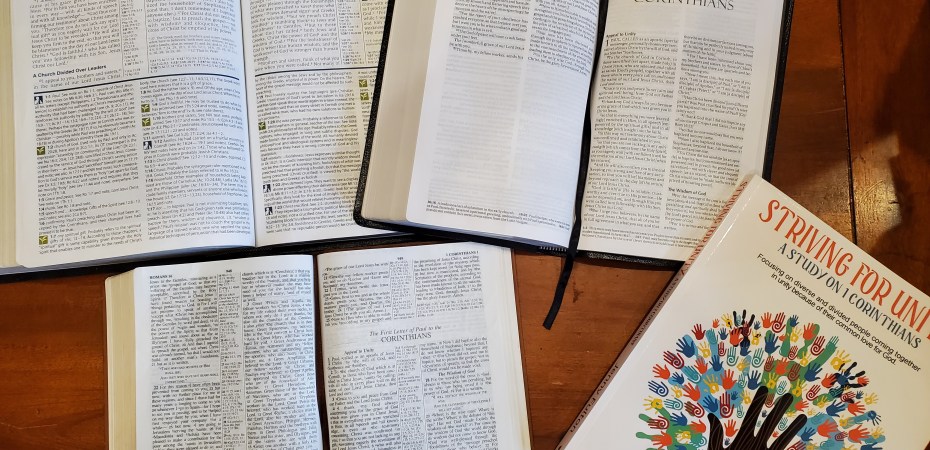
The Bible is one of those books you can read a thousand times and still discover something new and amazing each time you open it.
I grew up being encouraged to read my Bible. I learned about it in church and memorized the verses our Sunday School teachers gave us (you can read more about my church experiences here).
But I wanted to know more. By the time I turned twelve, I was paying more attention to the sermons. After church, my parents discussed what they thought of the day’s preaching–what they agreed or disagreed with. I started reading my Bible more so I could compare what I’d heard to what I saw and understood in Scripture. One year, I attempted a read-the-Bible-in-a-year plan, and did pretty well, until I hit somewhere in Leviticus… My older sister and I started studying the Bible together. We began a Bible Study with some of the other girls in the youth group. This essentially consisted of choosing a passage to read and discuss.
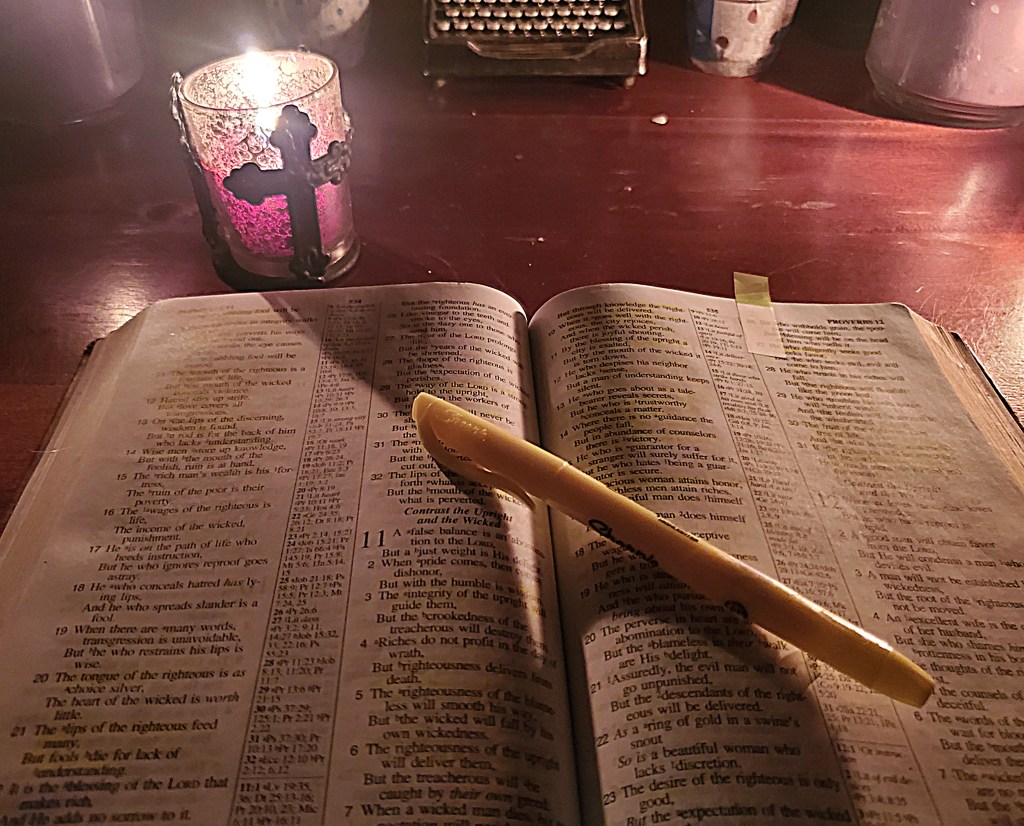
When I was 16, I signed up to go on a short-term mission trip with Teen Missions International. During the training stage, which they called “The Lord’s Boot Camp,” they gave us classes in how to study the Bible. One of the techniques they taught us consisted of using different colored highlighters to identify:
- Repeated words
- Key words
- Key phrases
- Nouns
- Verbs
The idea was that in doing so, you could better discover and understand what the passage was talking about, what God was trying to teach people.
With this step into formal Bible study, knowing the Bible became less about being familiar with the words and more about really delving into what they meant.
I was hooked and wanted to know more. I wanted someone to teach me more about how to study the Bible so I could read and learn for myself what God was saying. When it came time to choose a college, this yearning served as the primary motivation for choosing a Christian university.
Grace University required every student to receive a Bachelor’s degree in Bible in addition to whatever other major they were pursuing.

This was perfect! I was so excited to have classes that would actually teach me how to better understand God’s Word. Through those classes I learned:
- How asking questions before you read can open your mind to truths you may have missed because you didn’t think to look for them or you assumed you already knew the answer
- How reading a passage multiple times can cause different aspects of it to stand out to you
- How to use a Concordance to look up Greek and Hebrew words (does anyone use those massive hard-copy Concordances anymore?)
- How to research background information about a book of the Bible and the cultural and historical context of the book
- How to find and use commentaries to gain more insight into the context of the passage that I might now have been able to find otherwise.
By the time I graduated, I thought I had a pretty good grasp of how to study the Bible.
And then I met my husband and realized I had only scratched the surface.

John was a relatively new Christian. Although he’d grown up in the Catholic church and received a foundation for who God was, he’d rejected the Christian faith when he was in high school, deciding it was merely “for those who didn’t understand Quantum Physics.” More than a decade later, after he discovered his wife of ten years was cheating on him, he cried out to the God he hadn’t thought he believed in. “Either reveal Yourself to me or get the hell out of my life!”
Almost immediately, the name of a neighbor he’d barely spoken to came into John’s mind. Figuring he had nothing to lose, John walked over and knocked on the door.
The man opened the door and, without even offering a basic greeting, said, “You’re having marital trouble, aren’t you?”
At that moment, John realized two things.
- There was a God.
- He’d been an idiot.
In a rather dramatic fashion, John immediately began to pursue God with all his heart, soul, mind, and energy. He attended church and got involved in small groups and Bible Studies. When that wasn’t enough, a friend suggested he enroll in a local seminary. John followed the suggestion and was soon immersing himself in learning Greek and Hebrew so he could study the Bible in its original languages.
Seeking God didn’t help his marital situation, though. In fact, it seemed the closer John grew to God, the more resistance he received from his wife. After spending months trying to work things out in his marriage, throughout which she continued her affair and agreed to marry the other guy, John finally filed for divorce.
By the time I met him in 2011, John had been intensely pursuing God and studying His Word for less than two years. And with those measly months of focused study, he had a better grasp of many Biblical passages than I did.
Soon after we started dating, he invited me to study the Bible with him. Given my previous course of study in college, I didn’t think I’d have much trouble keeping up with him. But I was wrong.
We would study the Bible for hours at a time on the weekend, sometimes only covering a few verses.
John would ask question after question that I hadn’t thought of, would look up every single notation that was made in the Bible and study those passages to figure out how they related to the original passage we were looking at, what they told us about God, and how it was relevant to our lives.
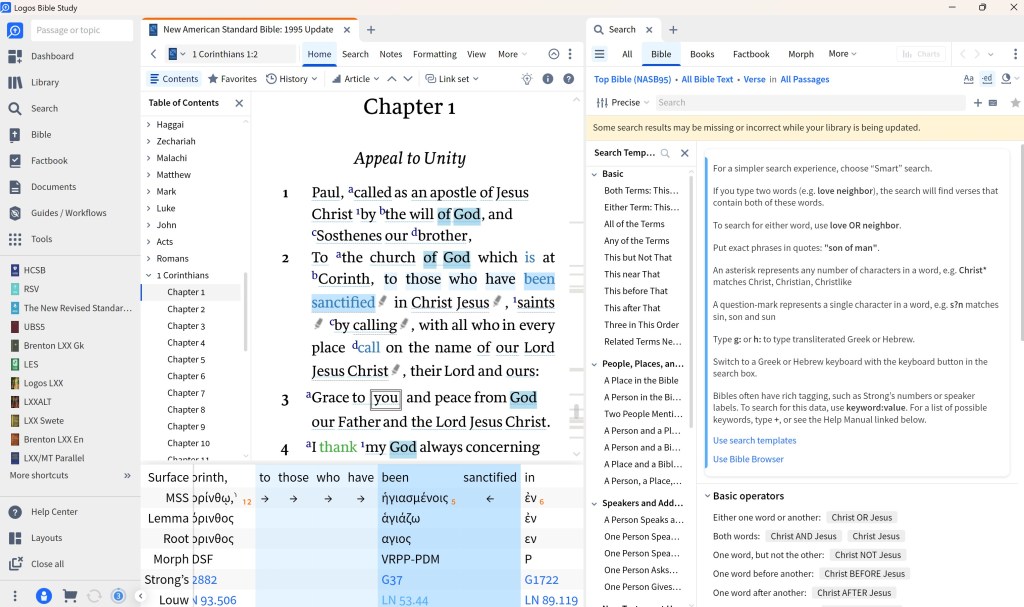
He showed me how to use the LOGOS Bible Study Software to look up the Greek and Hebrew words and do an in-depth study on what those words meant, if and how they changed our understanding of the passage, and how that understanding might impact our understanding and relationship with God.
My brain was utterly fried by the end of each study session. It isn’t easy to study for that long and intense period of time. But oh, the delicious joy that comes from receiving a greater grasp of truth after you’ve labored so hard to obtain it!
Fast forward several years, through our wedding in 2012 and the birth of our first two daughters in 2013 and 2016. In 2018, when I was expecting our third child, John and I decided to attend Camp Logos: a two-day training session on how to study the Bible using their Software program that we both enjoyed using so much.
The seminar, taught by Morris Proctor, drew people from all walks of life and a variety of church backgrounds. As described on their website for the camps (see link above), we learned such things as:
- Seeing the Big Picture
- Studying with Guides and Tools
- Searching the Resources
- Saving the Research
- Surveying the Reverse Interlinears
- Sizing Up the Biblical Text
I absolutely loved the training! Morris Proctor challenged us to set aside preconceived theologies when we study so that Scripture alone informs our theology rather than allowing theology to dictate our interpretation of Scripture. Each exercise he led us in felt like we were opening a door into a new world or getting a better and more complete view of one we already knew. It was the delight of fitting a few more pieces of a puzzle together, knowing you’re getting closer to discovering what the whole looks like.

Studying the Bible is an adventure. It’s an exciting treasure hunt that can lead us to unearth valuable gems of truth that contain the power to transform our understanding of who God is, how He interacts with people, how much He loves us, and how we can grow closer in our relationship with Him.
Because the ultimate point of Bible study isn’t to learn facts. It isn’t to acquire a wide base of knowledge that is more plentiful than anyone else’s. We study the Bible so that we may grow in our relationship with God, that we may abound more and more in love for Him and for each other.

 Heart Soul Mind
I’m so excited about this series as I am always looking for ways to dig deeper in God’s word…thank you!
LikeLiked by 1 person
[…] My Bible Study Journey (and what I’ve learned along the way) […]
LikeLike
[…] My Bible Study Journey (and what I’ve learned along the way) […]
LikeLike
[…] How to Study the Bible: My Bible Study Journey (and what I’ve learned along the way) […]
LikeLike
[…] My Bible Study Journey (and what I’ve learned along the way) […]
LikeLike
[…] How to Study the Bible: My Bible Study Journey (and what I’ve learned along the way) […]
LikeLike
[…] My Bible Study Journey (and what I’ve learned along the way) […]
LikeLike
[…] How to Study the Bible: My Bible Study Journey […]
LikeLike