
By Jenny Fulton
The Bible is full of incredible lessons that can help us grow closer in our relationship with God and with others.
Reading it is a wonderful practice. With your heart and mind directed toward God, He can speak to your spirit and reveal the wonderful light and truth that abounds in His Word.
Studying the Bible takes things a step further. It enables you to delve deeper, work harder, invest more of your time and energy to uncover even more life-giving truths that you may miss from a surface reading and contemplation.
Studying a book of the Bible allows you to explore passages in their full context, to become acquainted with the real people, with real problems, who followed a very real God. It helps you see, through a sharper lens, their joys, sorrows, and struggles, the setting in which they succeeded and failed and worked out their faith, just as many of us are doing today.
When we embark upon the study of an entire book of the Bible, rather than a chapter, verse, or short passage, we are better able to grasp hold of the big picture. This, in turn, makes it possible for us to understand where and how all the smaller pieces fit and how we can apply what we’re learning to our lives.
It takes time and perseverance – this isn’t an easy or short endeavor. But the greater understanding you can gain through this process is definitely worth it.
12 Steps for an In-Depth Book Study
Step 1: Pray

“But the Helper, the Holy Spirit, whom the Father will send in My name, He will teach you all things, and bring to your remembrance all that I said to you” John 14:26 (NASB95).
True knowledge and understanding is only granted by God. Before you begin each study session, ask God to help you understand the book and reveal what He wants you to learn from your time with Him as you dig into His Word.
Step 2: Identify What You Know

There’s an interesting phenomenon that happens when we think we know something: the learning part of our brain shuts off. After all, why engage the thought process and critical thinking skills with something you already know? Identifying what we think we know can help us be watchful of those moments where we may actually need to work harder to re-engage our minds.
List what you know about the book you’ll be studying.
For example:
- Do you know who wrote it?
- Have you heard people preach or teach on it before?
- What are your feelings and experiences with it?
- Do you have any favorite verses or passages from it?
- Are there any passages you already know you’ll struggle with?
As we go through the study, we may realize we know more than we thought we knew. Or we may realize we don’t know as much as we thought we did or that some of what we thought was true actually wasn’t or was only a smaller piece of a more complete truth. But that’s all part of the fun of this experience.
Step 3: Consider Your Background

As much as we may wish we could approach Scripture with neutrality, the reality is our past experiences influence our view and interpretation of what is written. Most of the time, we may not even recognize this is the case. Identifying these aspects of our life and mindset from the get-go can help us better study the book by alerting us to passages with which we may struggle or those with which we may have a deeper understanding and connection.
For example:
- How long have you been a Christian?
- What is your religious background?
- Did you grow up in the church?
- What is your experience with Christianity and churches?
- What did your parents believe?
- How familiar are you with the Bible?
- Have you been through any tough experiences that may have impacted your ideas and beliefs of who God is?
Step 4: Identify What You Don’t Know

Questions prepare our minds to learn, reveal what’s important to us, and point to what we may want to study further.
Asking (and writing down) questions about the book as a whole and before each study time opens our mind and spirit to consider where God is working in our lives and what we’re more specifically seeking to know. When we ask questions, we’re acknowledging we don’t know everything and need God’s help to receive wisdom and understanding.
Write down any questions you have about the book as a whole and the content within it. Keep track of these and make note of which ones are answered as you go through the study.
Step 5: Research Background Information about the Book

Knowing the historical and cultural context can give us a better idea of who the people were, the struggles they faced, any similarities and differences to our times and our trials, how the Scriptures may have applied to them, and any similarities and differences as to how those same Scriptures, coming from the same God, apply to us today.
For example, when I was studying 1 Corinthians, I discovered the Christian church in Corinth was highly diverse, consisting of people from various cultures, religious backgrounds, and socioeconomic statuses. That’s similar to many churches today. It helps explain some of their conflicts and some of Paul’s direction to them throughout the book. If churches then and now contain diverse people who encounter conflicts with each other, it stands to reason that Paul’s letter contains principles which can also be applied today. (You can learn more about my findings on 1 Corinthians in my Bible Study, Striving for Unity: a Study on 1 Corinthians.)
Normally, I like to avoid reading commentaries until I’ve done my own study. However, Study Bibles, internet searches, and commentaries are wonderful tools in searching for background information that we can’t get directly from the Biblical text.
Some questions you may ask and facts you may search for include:
- Who was the book written to – not just what’s in the text, but who were these people – what was their cultural and religious background?
- Where were the writer and audience living?
- What were those locations like?
- What was going on at the time in terms of politics, cultural, historical events?
Step 6: Read the Book
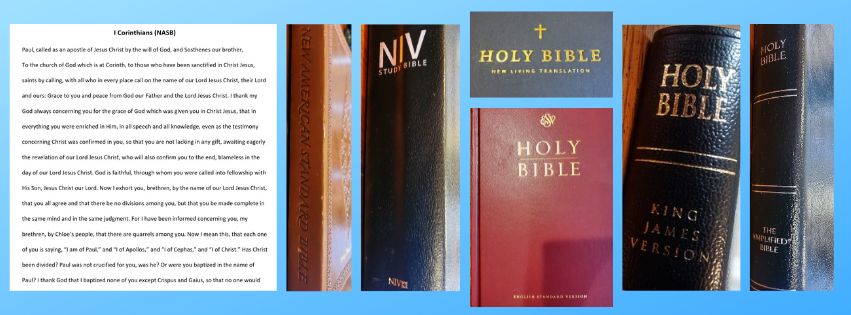
Read the book of the Bible you are planning to study multiple times. Something different may standout to you in each read-through. Certain words may consistently catch your attention. Questions you hadn’t thought of may arise.
Read the book at least once without heading, chapter, or verse breaks. This enables you to see the book as a whole and form your own conclusions about where the subjects within it begin and end. It isn’t easy to find versions of the Bible this way, so you can create your own by either looking at a physical copy and typing out the words without headings, chapters, or verses. Or you can copy and paste from an online version, then go through and remove those elements.
Read the book from different versions. This gives you an idea of the various ways some of the passages are translated. One translation may resonate with you more than others or cause an idea to stand out.
Step 7: Listen to the Book

Listen to an audio version of the book at least once or twice. This can be on YouTube or any other audio app/device you have. We sometimes pick up on different things when we listen than we do when we read. If you can’t find a good recording, you can get a similar effect by reading the book out loud or listening to someone else read it.
Take as much time as you need to read and listen to the book, but don’t try to study or research anything at this point. The idea is to allow the book as a whole to wash over you and enable you to become more familiar with the content before you dive deeper.
Step 8: Take Notes

As you read and listen, take notes about what stands out to you.
- Write down any questions that come to mind.
- Observations can be anything you think is interesting: names, words, phrases, instructions, or anything else that catches your eye.
- Repeated words can give you an idea of some of the themes.
Step 9: Chapter by Chapter

Read the chapter multiple times (from the same or different versions) and listen to it read aloud. Now that you have a greater idea of the book as a whole, focus in on the chapter to pull out the details. Note any observations you have, repeated words and themes you notice, and questions you have.
What is the main point (the what) and purpose (the why) of the chapter?
Step 10: Verse by Verse

Read and think about each verse.
- Ask questions.
- Compare the wording in various translations. Does the word choice impact the overall meaning, provide greater clarity, make it more confusing, etc?
- Look up and study the Greek or Hebrew words for any words or verses you want a greater understanding of. The LOGOS Bible Study software or app is a great way to do this. Bible Hub and Scripture 4 All are two online sources I found that provide a way for you to see the Greek and Hebrew translations. Does discovering the original, literal meaning of the original language impact your understanding of the verse and chapter?
- Some resources for learning more about the Greek and Hebrew words and definitions (included w/ LOGOS software): The Theological Dictionary of the New Testament, Greek-English Lexicon of the New Testament, Strong’s Exhaustive Concordance of the Bible, Strong’s Hebrew-Aramaic Dictionary of the New American Standard Exhaustive Concordance
- Look up any notations in your Bible. Do the other verse references impact your understanding of the verse/chapter/book?
- How does each verse relate to the rest of the chapter? How does it fit with any themes you are seeing in the book as a whole?
Step 11: Chapter Application

When you have reached the end of the chapter, consider what you’ve learned.
- What stood out to you?
- Did you answer any of the questions you asked?
- Did you discover any principles you can apply to your life? What is one way you can apply them?
- Did you learn anything new about God – His character, how He relates to people, etc.?
- Did you learn anything new about human character, how we should interact with each other?
- Did you learn anything new about yourself?
- Has your relationship with God been impacted through studying this chapter?
Repeat Steps 9-11 of this process for the rest of the book.
Step 12: Book Application

Once you’ve finished studying the entire book, try to summarize what you’ve learned and how you can apply those lessons to your life.
Has your understanding of God and your relationship with Him changed as a result of your study?
Would God have you share your findings with anyone else?
Pray and thank God for the opportunity to study His Word and for giving you the strength, endurance, and insight you needed to do so.
My Book Bible Study
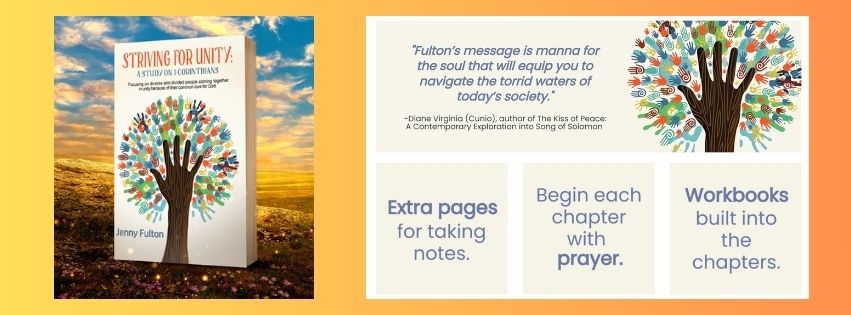
In my Bible Study, Striving for Unity: a Study on 1 Corinthians, I lead the reader through these steps to discover how Paul encourages diverse and divided Christians to come together in unity.
 Heart Soul Mind
[…] How to Study a Book of the Bible […]
LikeLike
[…] How to Study a Book of the Bible […]
LikeLike
[…] How to Study the Bible: How to Study a Book of the Bible […]
LikeLike
[…] How to Study a Book of the Bible […]
LikeLike
[…] How to Study the Bible: How to Study a Book of the Bible […]
LikeLike
[…] How to Study a Book of the Bible […]
LikeLike
[…] How to Study the Bible: How to Study a Book of the Bible by Jenny Fulton […]
LikeLike