
By Jenny Fulton
Bible Word Studies can greatly expand our understanding and appreciation of God’s Word. They can open our eyes to even greater truths that can help us grow stronger in our relationship and walk with God. The more we learn to love and walk with God, the better able we are to love those around us as well.
Words are amazing. We use them to communicate thoughts and feelings, to give directions, share ideas and stories, impart encouragement and comfort, bring correction, and so much more. They impact our relationships, our perceptions of reality, and our understanding of the world.
Words are complicated. Many have a basic, easily definable meaning (denotation); and a complex, beneath-the-surface, varies by person, feeling-driven, experience-backed, harder-to-define, long-winded, associated idea meaning (connotation). There are multiple words with the same basic denotation but completely different connotations. And those connotations may differ across cultures and generations.
So, when it comes to reading and studying the Bible, understanding the words and their meanings may not always be as simple and straightforward as it initially seems.
When I was attending Grace University, which included mandatory Bible classes, one of my favorite assignments was completing a Bible word study. There is so much to explore with this type of research! So many questions you can ask. So much you can discover.
For example, when you say the word, ‘saved,’ to anyone remotely familiar with Christianity, most will immediately think of what it means to believe in Christ with the promise of eternal life (or some other such similar phrasing). However, the Bible uses that word in many other contexts. Who was being rescued? Who rescued them? What were they being rescued from?
One word I’m (slowly) studying now is ‘submission.’ That’s a fun one, right? Talk about a word that, depending on the audience and context of its usage, has all kinds of negative connotations. But what does it really mean? Throughout the Bible, who or what submits to whom? What is the nature of each entity involved? Why do they, or why are they told/asked/commanded to submit? What do those relationships truly look like? What does the word mean in the original Greek and Hebrew? (I may share my findings in an article, or five, or a book – only God knows at this point.)
In this article, as in the others in this series, I’ve broken down the process I’ve used for Bible Word Studies. Sometimes I engage in every step, sometimes I only use a few. It all depends on the word, time, resources, your goals and reason for studying, and God’s guidance.
12 Steps to Study a Word or Concept in the Bible
Step 1: Consider Why

Why, out of countless words in the Bible, is this word or concept catching your attention?
Is it related to a challenge you’ve faced or are facing?
A teaching you’ve heard and either agreed or disagreed with?
Conversations you’ve heard among acquaintances or seen online or in the news?
Is it connected to something in your life God is trying to teach you?
You have no idea why you’re interested, but it just keeps popping up in your mind like an annoying commercial jingle?
God rarely tells us exactly why He’s leading us in a particular direction, but thinking about some of these questions can open our minds to be aware of what might be driving our interest. What questions should we be asking? What are we hoping to gain from the study? What does God want to show us? Say to us?
Step 2: Pray

“But the Helper, the Holy Spirit, whom the Father will send in My name, He will teach you all things, and bring to your remembrance all that I said to you” John 14:26 (NASB95).
Ask God to show you how to go about this study, help you understand the word/concept, the meaning and relevance of the passages it’s found in, and to reveal what He wants you to learn from your time with Him as you dig into His Word.
Step 3: Identify What You Know

When we think we know something, it’s harder to learn anything new about the subject or to adjust our understanding of it. Identifying what we know can help us be watchful of those moments where we may actually need to work harder to re-engage our minds. Asking questions and challenging our knowledge of the topic helps in this area as well.
List everything you know about the word/concept you’ll be studying. For example:
- What is the denotation and connotations of the word/idea?
- What verses have you heard it used in?
- Is there a specific verse or verses with that word that keep coming to mind?
- What conversations or sermons have you heard on it?
- What are your initial ideas about what it means and how it’s used in the Bible?
Step 4: Search for English Word Usage
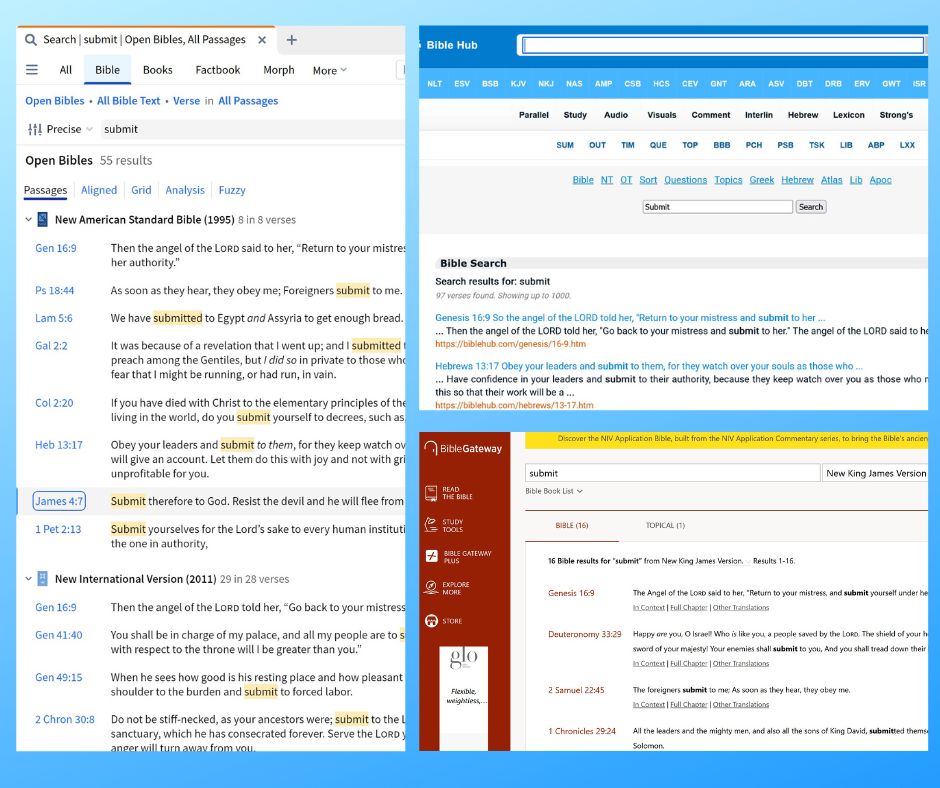
Using one or more Bible translations, search for every time that word/concept shows up in the Bible. Some searches may automatically include other forms of the word while others may require you to create a different search for each. For example, save, saved, saving, salvation…
Some tools you can use for your search include:
- Strong’s Exhaustive Concordance of the Bible (or any Concordance)
- Concordance or Index at the back of Study Bibles
- LOGOS Bible Study Software (my personal favorite)
- BibleGateway
- Bible Hub
Depending on the type of study, you can filter your search by verses that show up in the Old Testament or New Testament.
Step 5: Record Each Verse
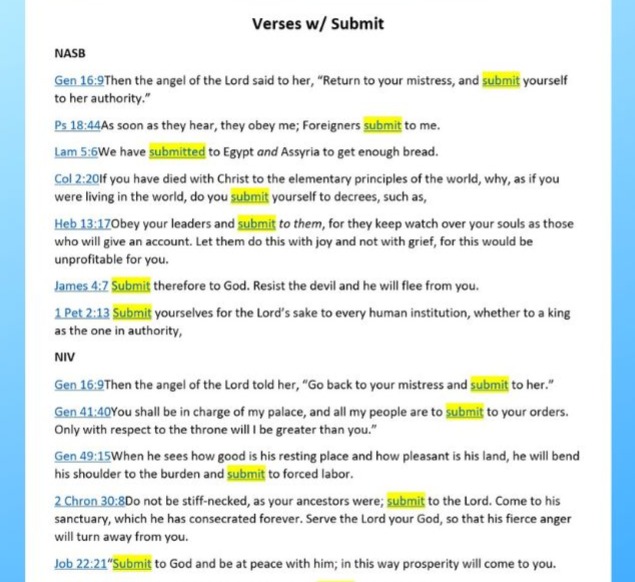
Briefly read each verse. You don’t need to spend much time on it at this point as you’re merely gathering overview information.
Due to the irritating existence of homonyms, determine which words/verses actually fit the meaning/concept you’re studying and write/type/copy-paste those verses in one document. They are, essentially, the key verses you’ll be studying.
Highlight the word/concept in each verse.
Step 6: Skim, Observe, Compare
Re-read each verse on your list.
Compare: What similarities and differences do you notice between the verses/word usage?
Observe: Does anything else stand out? Theme? Audience? Close associations between your key word/concept and other words or ideas in the verses?
Make note of any observations.
Step 7: Read and Compare Different Translations.

Look up each key verse in different Bible translations.
Great places to find and compare translations if you don’t have a dozen physical copies of your own laying around:
- LOGOS Bible Study Software
- BibleGateway
- Bible Hub
- Bible Study Tools
- bible.com (YouVersion Bible app)
Record any other words that are used in place of the key word/concept you’re studying. For example, in my study on submission, I found the following translation for Ephesians 5:21 (emphasis added).
- NASB: “and be subject to one another in the fear of Christ.”
- NIV: “Submit to one another out of reverence for Christ.”
- KJV: “Submitting yourselves one to another in the fear of God.”
- Young’s Literal Translation: “Subjecting yourselves to one another in the fear of God.”
Ask and Consider:
- Why were different words used?
- What are the similarities and differences between the English denotations and connotations of each word?
- Does the word choice impact the overall meaning, provide greater clarity, make it more confusing, etc?
Step 8: Look up the Greek or Hebrew Word Usage
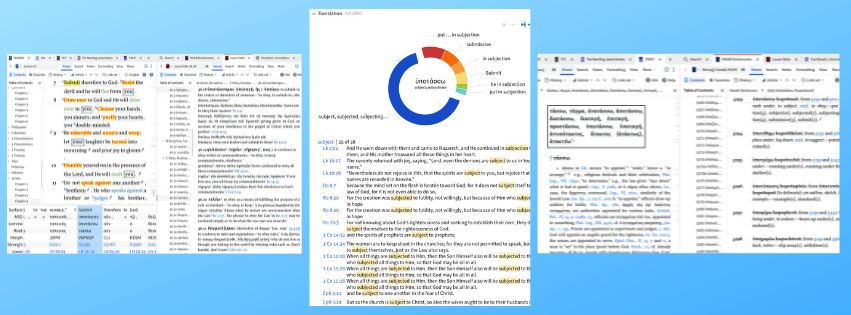
Look up the original Greek or Hebrew for the word you’re studying and any other words in the verses that you want a greater understanding of.
Great places to find Greek/Hebrew translations:
I like to make note of each Greek/Hebrew translation used for my key word, then sort the verses according to the words used in the original language. For example, in my word study on ‘submission,’ I found 11 different Hebrew words and 5 Greek ones that were translated as some form of the English word, ‘submit’. However, only one of the Greek words fit the concept I’m studying.
Compare the original meaning with the English denotations and connotations of the word.Does discovering the original, literal meaning of the original language impact your understanding of the word/concept?
Some resources for learning more about the Greek and Hebrew words and definitions:
- LOGOS Bible Study Software
- The Theological Dictionary of the New Testament
- Greek-English Lexicon of the New Testament
- Strong’s Exhaustive Concordance of the Bible
- Strong’s Hebrew-Aramaic Dictionary of the New American Standard Exhaustive Concordance
LOGOS also has a fun Bible Word Study feature that enables you to see all the English words that the Greek/Hebrew word is translated as in different Bible versions. It also lists all the verses each English word is found in. This also provides an opportunity to add more verses that contain that same Greek/Hebrew word to your list.
Step 9: Carefully Read Each Verse

Now that you have an overview of the word/concept, and a better idea of the original meanings (if you chose to include that step), carefully read each verse in your list. Make observations. Underline any key words or phrases that stand out to you. Ask questions. Answer the ones you can and try to answer the rest as you go through the rest of the study.
Some questions you may ask:
- What is your initial understanding of the verse/passage and the significance of the word/concept you’re studying?
- What stands out to you?
- Who is speaking?
- Who is the audience?
- What is the topic/main idea?
- Why is the topic important?
- What does the speaker say about the topic?
- What is the context – what was the speaker talking about before and after the section you read?
Step 10: Read Before and After Each Verse
Read the verse before and after the one you’re studying. Back up and read a few more verses before and after.
- Where does the subject of that word/concept begin and end?
- What is the context for it?
- How does seeing the greater context of the verse impact your understanding?
Step 11: Summarize

Write a summary of what you learned. What is the main principle/truth/teaching of the word/concept? Who does it apply to? In what situation/s does it apply? Why is it important?
Step 12: Pray and Apply

Think about everything you’ve learned. What did you learn about God through the study? Ask God to show you what He wants you to take away and how He would have you apply it to your life. Ask Him to give you the strength and wisdom to live out what you’ve learned and to grow closer in your relationship with Him.
Continue to seek Him.
Examples of Word/Concept Studies
- The God Destroyer and the Path to Righteousness
- What is Life? What is Death? Are Zombies Real?
- What is Salvation?
- Victory in Christ over Spiritual Enemies
- Victory in Christ over Fear
 Heart Soul Mind
[…] How to Study a Word or Concept […]
LikeLike
[…] How to Study a Word or Concept […]
LikeLike
[…] How to Study the Bible: How to Study a Word or Concept […]
LikeLike
[…] How to Study a Word or Concept […]
LikeLike
[…] How to Study a Word or Concept […]
LikeLike
[…] How to Study the Bible: How to Study a Word or Concept […]
LikeLike