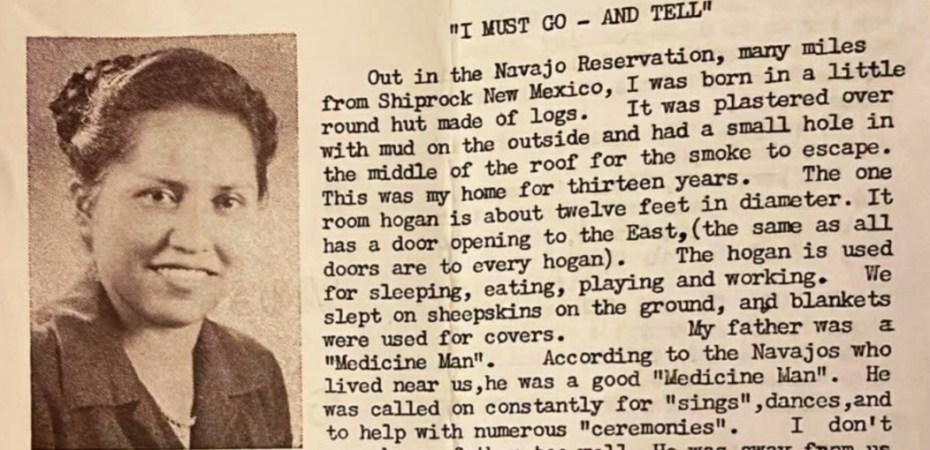
By Lillian (Deshnod) Litfin; (May 10, 1934 – May 29, 2023)
Shared by Jenny (Litfin) Fulton
For years, I’ve been trying to piece together some of the facts and events from my Grandma Lillian’s early life. A few months ago, A.J. Trujillo, the superintendent at Torreon Navajo Mission, came across some of her writings from before she was married. He took pictures and sent them to me. One was her autobiography that she appears to have written, possibly in the fall of 1954 (I’m not certain of the exact date), for a newsletter of some kind while attending the Great Commission School in Indiana. The other was an article she titled, “My Testimony,” written in September 1955.
Since first person accounts of Native Americans in this period seem to be less common, I’ve included a timeline at the end for the history buffs and other curious persons. The dates come from Grandma’s writings and from information found in the book, They Counted the Cost: The History of the Dunkard Brethren Church from 1926-2008 by Keith M. Bailey.
This is my grandma Lillian (Deshnod) Litfin’s story, in her own words.
“I MUST GO – AND TELL”
by Lillian Deshnod
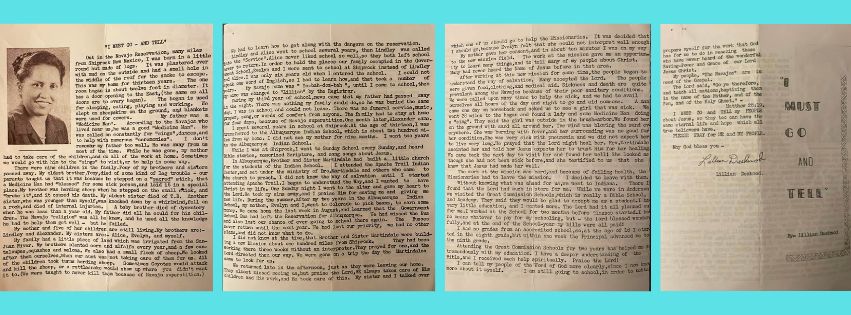
Out in the Navajo Reservation, many miles from Shiprock, New Mexico, I was born in a little round hut made of logs. It was plastered over with mud on the outside and had a small hole in the middle of the roof for the smoke to escape. This was my home for thirteen years. The one room hogan is about twelve feet in diameter. It has a door opening to the East (the same as all doors are to every hogan). The hogan is used for sleeping, eating, playing, and working. We slept on sheepskins on the ground, and blankets were used for covers. My father was a “Medicine Man.” According to the Navajos who lived near us, he was a good Medicine Man. He was called on constantly for “sings,” dances, and to help with numerous ceremonies. I don’t remember my father too well. He was away from us most of the time. While he was gone, my mother had to take care of the children and do all of the work at home. Sometimes we would go with him to the sings to visit, or to help in some way.
There were nine children in the family. Four of my brothers and sisters passed away. My oldest brother, Tony, died of some kind of leg trouble – our parents taught us that it was because he stepped on a “sacred” stick that a Medicine Man had “blessed” for some sick person and had laid it in a special place. My brother was herding sheep when he stepped on the small stick and “broke it,” and it caused his death. My oldest sister died of T.B. Another sister, who was younger than myself, was knocked down by a whirlwind, fell on a rock, and died of internal injuries. A baby brother died of dysentery when he was less than a year old. My father did all he could for his children. The Navajo “religion” was all he knew, and he used all the knowledge he had to help them get well – but he failed.
My mother and five of her children are still living. My brothers are Lindley and Alexander. My sisters are Alice and Evelyn.
My family had a little piece of land which was irrigated from the San Juan River. My brothers planted corn and alfalfa every year, and a few cantaloupes, squash, and melons. We also had a small flock of sheep. We looked after them ourselves, when our aunt was not taking care of them for us. All of the children took turns herding sheep. Sometimes, Coyotes would attack and kill the sheep, or a rattlesnake would show up where you didn’t it to. (We were taught to never kill them because of Navajo superstition.)
We had to learn how to get along with the dangers on the reservation.
Lindley and Alice went to school several years, then Lindley was called into the “Service.” Alice never liked school so well, so they both left school, never to return. In order to hold the places our family occupied in the Government School, Evelyn and I were sent to school at Shiprock instead of Lindley and Alice. I was only six years old when I entered the school. I could not speak one word of English, so I had to learn how, and that took a number of years. My Navajo name was “Ye-bah-doz-bah,” until I came to school, then my name was changed to “Lillian” by the Registrar.
During my third year of school, news came that my father had passed away in the night. There was nothing my family could do, so he was buried the same day. I was in school and could not leave. There was no funeral service, music, prayer, song, or words of comfort from anyone. The family had to stay at home four days, because of Navajo superstition. One month later, Alexander came.
I spent several years in school at Shiprock. At the age of thirteen, I was transferred to the Albuquerque Indian School, which is about two hundred miles from my home. I did not see my mother for nine months. I went two years to the Albuquerque Indian School.
While I was at Shiprock, I went to Sunday School every Sunday and heard Bible stories, memorized Scripture, and sang songs about Jesus.
In Albuquerque, Brother and Sister Martindale had built a little church for the students of the Indian School. I attended the Apache Trail Indian Center, and sat under the ministry of Bro. Martindale and others who came to the church to preach. I did not know the way of salvation until I started attending Apache Trail. I began to understand the Way, and I wanted to have Christ in my life. One Sunday night I went to the alter and gave my heart to the Lord. He took my sins away, and I praise Him for saving me and giving me new life. During the summer, after my two years in the Albuquerque Indian School, my mother, Evelyn, and I went to Colorado to pick beans to earn some money. We came home the last week in August and learned that the Government School Bus had left the Reservation for Albuquerque. We had missed the bus and also lost our chance of ever going to school there again. The busses never return until the next year. We had lost our priority, we had no other plans, and did not know what to do.
I did not know at the time that Brother and Sister Martindale were building a new Mission about one hundred miles from Shiprock. They had been working there three weeks without an interpreter. They prayed for one, and the Lord directed them our way. We were gone on a trip the day the Martindales came to look for us.
We returned late in the afternoon, just as they were leaving our home. They almost missed seeing us, but praise the Lord, HE always takes care of His children and His work, and He took care of this. My sister and I talked over which one of us should go to help the Missionaries. It was decided that I should go, because Evelyn felt that she could not interpret well enough.
My mother gave her consent, and in about ten minutes I was on my way to the new mission field. The work at the mission gave me an opportunity to learn many things, and to tell many of my people about Christ. Many had never heard the Name of Jesus before in that area.
After working at this new mission for some time, the people began to understand the way of salvation. Many accepted the Lord. The people were given food, clothing, and medical aid. Sickness and death are quite prevalent among the Navajos because of their poor sanitary conditions. We were called upon many times to help the sick, and we had to avail ourselves all hours of the day and night to go and aid someone. A man came one day on horseback and asked us to see a girl that was sick. We went 28 miles to the hogan and found a lady and some Medicine Men doing a “sing.” They said the girl was outside in the brush-arbor. We found her on the ground with sand all around her. The wind was blowing the sand everywhere. She was burning with fever, and her surrounding was no good for her condition. She was very sick with pneumonia and we did not expect her to live very long. We prayed that the Lord might heal her. Rev. Martindale anointed her and told how Jesus expects her to trust Him for her healing. We came back the next day to visit her and found her well! She looked as though she had not been sick before, and she testified to us that she knew Jesus had made her well.
The work at the mission was hard, and because of failing health, the Missionaries had to leave the mission. I decided to leave with them.
Without knowing what was ahead for us, we went to Indiana. There I found that the Lord had much in store for me. While we were in Anderson, we visited the Great Commission School, which is really a Bible School and Academy. They said they would be glad to accept me as a student. I had very little education, and I wanted more. The Lord had it all planned out for me. I worked at the School for two months before classes started. I had no means whatever to pay for my schooling, but – the Lord blessed wonderfully, and at the end of the school-year, my bills were all paid!
I had no grades from an accredited school, so, at the age of 18, I started in the eighth grade, but within one week the Principal advanced me to the ninth grade.
Attending the Great Commission School for two years has helped me so tremendously with my education. I have a deeper understanding of the Bible, and I received much help spiritually. Praise the Lord!
I can tell my people the Word of God more clearly, since I now know more about it myself. I am still going to school in order to better prepare myself for the work that God has for me to do in reaching those who have never heard of the wonderful Saving-Power and Grace of our Lord Jesus Christ.
My people, the Navajos, are in need of the Gospel.
The Lord said, “Go ye therefore, and teach all nations, baptizing them in the name of the Father, and of the Son, and of the Holy Ghost.” – Matthew 28:19.
I MUST GO and TELL my PEOPLE about Jesus, so they too can have the same eternal life and hope which all true believers have.
PLEASE PRAY for ME and MY PEOPLE.
May God bless you –
Lillian Deshnod
MY TESTIMONY – SEPTEMBER 1955
By Lillian Deshnod
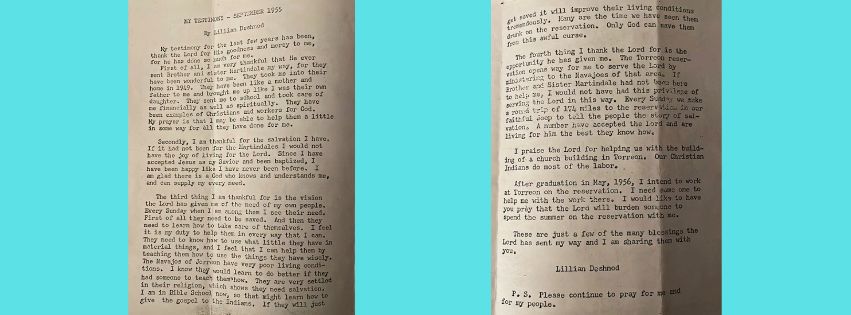
My testimony for the last few years has been, thank the Lord for His goodness and mercy to me, for he has done so much for me.
First of all, I am very thankful that He ever sent Brother and Sister Martindale my way, for they have been wonderful to me. They took me into their home in 1949. They have been like a mother and father to me and brought me up like I was their own daughter. They sent me to school and took care of me financially as well as spiritually. They have been examples of Christians and workers for God. My prayer is that I may be able to help them a little in some way for all they have done for me.
Secondly, I am thankful for the salvation I have. If it had not been for the Martindales I would not have the joy of living for the Lord. Since I have accepted Jesus as my Savior and been baptized, I have been happy like I have never been before. I am glad there is a God who knows and understands me, and can supply my every need.
The third thing I am thankful for is the vision the Lord has given me of the need of my own people. Every Sunday when I am among them I see their need. First of all they need to be saved. And then they need to learn how to take care of themselves. I feel it is my duty to help them in every way that I can. They need to know how to use what little they have in material things, and I feel that I can help them by teaching them how to use the things they have wisely. The Navajos of Torreon have very poor living conditions. I know they would learn to do better if they had someone to teach them how. They are very settled in their religion, which shows they need salvation. I am in Bible School now, so that [I] might learn how to give the gospel to the Indians. If they will just get saved it will improve their living conditions tremendously. Many are the time we have seen them drunk on the reservation. Only God can save them from this awful curse.
The fourth thing I thank the Lord for is the opportunity he has given me. The Torreon reservation opens [the] way for me to serve the Lord by ministering to the Navajos of that area. If Brother and Sister Martindale had not been here to help me, I would not have had this privilege of serving the Lord in this way. Every Sunday we make a round trip of 174 miles to the reservation in our faithful Jeep to tell the people the story of salvation. A number have accepted the Lord and are living for him the best they know how.
I praise the Lord for helping us with the building of a church building in Torreon. Our Christian Indians do most of the labor.
After graduation in May, 1956, I intend to work at Torreon on the reservation. I need some one to help me with the work there. I would like to have you pray that the Lord will burden someone to spend the summer on the reservation with me.
These are just a few of the many blessings the Lord has sent my way and I am sharing them with you.
Lillian Deshnod
P.S. Please continue to pray for me and for my people.
Timeline of Lillian Deshnod’s Early Life
May 10, 1934: Ye-bah-doz-bah (or Yii-baa-doz-baa’ as I’ve seen it spelled elsewhere) was born. Her name means, “a person who feels sorry for someone and helps them.”
Aug. 1940; age 6: Ye-bah-doz-bah began attending the Government (boarding) School in Shiprock, New Mexico. They changed her name to Lillian.
1943; age 9: Lillian’s dad died.
Aug. 1947; age 13: Lillian began attending the Albuquerque Indian School (another boarding school).
Aug. 1949; age 15: Lillian missed the bus to the Albuquerque Indian School. She left home to live with Ray and Mary Martindale, serving as a missionary and interpreter at Torreon Navajo Mission.
Summer 1952; age 18: Lillian moved to Anderson, Indiana with the Martindales and began attending the Great Commission School.
1954; age 20: Lillian wrote the article, “I Must Go – And Tell.”
Sept. 1955; age 21: Lillian wrote the article, “My Testimony.”
Feb. 1956: Ray Martindale began talking to the Dunkard Brethren Church about the possibility of them purchasing and running Torreon Navajo Mission.
May 1956; age 22: Lillian graduated from the Great Commission School.
June 1956: Lillian attended the Dunkard Brethren General Conference and became the first Navajo member of the church.
June or July 1956: The Dunkard Brethren Church finalized the purchase of Torreon Navajo Mission. Lillian returned to live at the mission and serve as a missionary and interpreter. She also taught many of the Navajo people how to read in their own language.
April 6, 1958; age 23: Lillian Deshnod married Galen Litfin, a Dunkard Brethren preacher from Oregon. Theirs was the first wedding at Torreon Navajo Mission.

